
When it comes to specifying commercial kitchen ventilation, the hood is one of the most consequential decisions on a project. It affects HVAC load calculations, make-up air design, energy performance, code compliance, and long-term operational costs for your client. That's why we recently completed training with Gaylord Ventilation — a brand with over 75 years in commercial kitchen exhaust — to sharpen our ability to specify the right system for every project.
Here's what you need to know.
The Gaylord Hood Family: Three Tiers, One Philosophy
Gaylord's ventilation lineup is built around their EL platform, stepping up in capability and efficiency across three main series. Knowing the differences lets you match the right hood to the right project from day one.
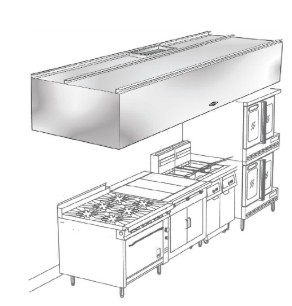
EL Series — The Smart Value Play
The EL Series is Gaylord's entry-level hood — and entry-level shouldn't be mistaken for basic. It's ETL Listed to UL standard 710, IMC and NFPA-96 compliant, and rated for the lowest CFM in its class as independently tested to ASTM 1704 requirements.
This is the go-to specification for light-duty cooking equipment — ovens, steamers, kettles — where you need a reliable, cost-effective solution without over-engineering the system. Notable spec features include a Super Capture™ lip for improved containment, optional XGS High Efficiency Grease Extractor (up to 96% efficiency on particulates 5–7 microns), 300 series stainless steel construction, LED lighting compatibility, and a standard balancing damper.
Best for: Light-duty cooklines where budget is a priority and performance still has to deliver.
ELX Series — High Efficiency Through Passive Design
The ELX uses the natural thermal plume rising from cooking equipment — not mechanical fans or active components — to capture and contain exhaust at the lowest possible air volumes. Every CFM reduced has a downstream impact: smaller fans, smaller make-up air equipment, reduced duct sizing, lower energy loads.
Key design advantages: up to 37% lower CFM than competing systems, static pressure resistance up to 65% below other designs, and nearly 25% quieter operation (around 55dB vs. the industry standard 65–75dB). It also supports LEED and sustainability goals directly, since every CFM saved reduces both exhaust and supply air system loads.
Best for: Medium-to-heavy duty cooklines where energy performance, LEED points, or long-term operating cost reduction are project priorities.
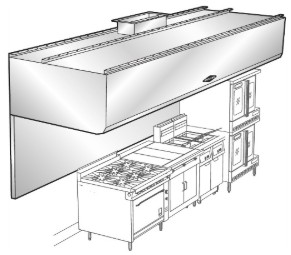
ELXC Series — Clean-In-Place, Built on the ELX Platform
The ELXC adds an automated clean-in-place (CIP) water wash system to the ELX. Instead of staff manually pulling, washing, and reinstalling grease filters, the ELXC handles it automatically — triggered by cooking frequency. For clients managing high-volume operations or facilities with staffing challenges, the labor savings are real, and the reduction in grease buildup means lower fire risk too.
Grease extraction efficiency runs up to 33% higher than competitive systems, the wash cycle uses up to 24% less water than other wash-hood designs, and sound levels are up to 27% below competing hoods.
Best for: High-volume, heavy-duty kitchens where labor optimization and fire safety are top priorities.
Eliminator — Smoke and Odor Control, All in One Unit
For projects involving charbroiling or high-smoke cooking — or clients in urban and mixed-use environments where exhaust air quality is scrutinized — the Eliminator is the conversation to have.
It's an all-in-one pollution control ventilator that integrates directly into the hood, combining an XGS High Efficiency Grease Extractor, super-charged UV technology, electrostatic smoke precipitation (ESP), automatic clean-in-place water wash, and odor negation — all within a 30" profile. No separate rooftop or mechanical room pollution control unit required. That simplifies your mechanical drawings, eliminates coordination headaches, and frees up space that would otherwise be consumed by traditional remote PCU installations.
Best for: Urban or mixed-use projects, charbroil-heavy menus, or any client where smoke, odor, and air quality compliance are non-negotiable.
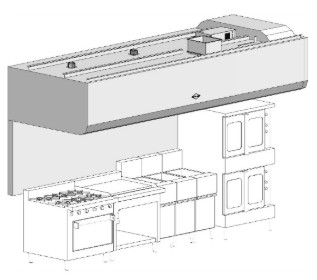
A Critical Design Note: Make-Up Air Makes or Breaks Hood Performance
Gaylord was direct about this during training — the number one reason for smoke loss in exhaust hoods is make-up air. The best hood will underperform if the make-up air system isn't properly designed and balanced. Coordinate the make-up air strategy early; it's not an afterthought.
Let's Talk About Your Next Project
We completed this training specifically to better serve our clients on kitchen ventilation specifications. Whether you're early in programming or deep in design development, our team can help you identify the right Gaylord system for your application — and make sure the full mechanical system is set up to perform.
For more information and to engage with our team, please contact us via our contact form or at (866) 503-2655. We look forward to working with you to provide the best solutions for your needs.
LET'S FIND YOUR SOLUTION
Rapids Contract & Design serves the United States with locations in Iowa, Minnesota, and Missouri. Our experts are ready to assist with your foodservice needs—contact us for support, Monday through Friday, 8 AM to 5 PM CST.
or call (800) 899-6604