
Last week, Chris Simerda, Solutions Engineer from our MO branch, had the opportunity to step inside the manufacturing facility of Continental Refrigerator in Philadelphia, PA, and it’s the kind of visit that reshapes how you think about specifying refrigeration in foodservice design.
A Legacy Built on American Manufacturing
Continental Refrigerator has been building commercial refrigeration equipment in the United States for decades, with a strong emphasis on durability, serviceability, and practical field performance. That “made in the USA” mindset isn’t just marketing, it shows up in how their cabinets are engineered, how components are laid out, and how service access is prioritized.
Cabinet Flexibility: Designing for the Real World
One of the biggest takeaways from the visit was just how flexible their cabinet platforms really are. From a design standpoint, this is huge.
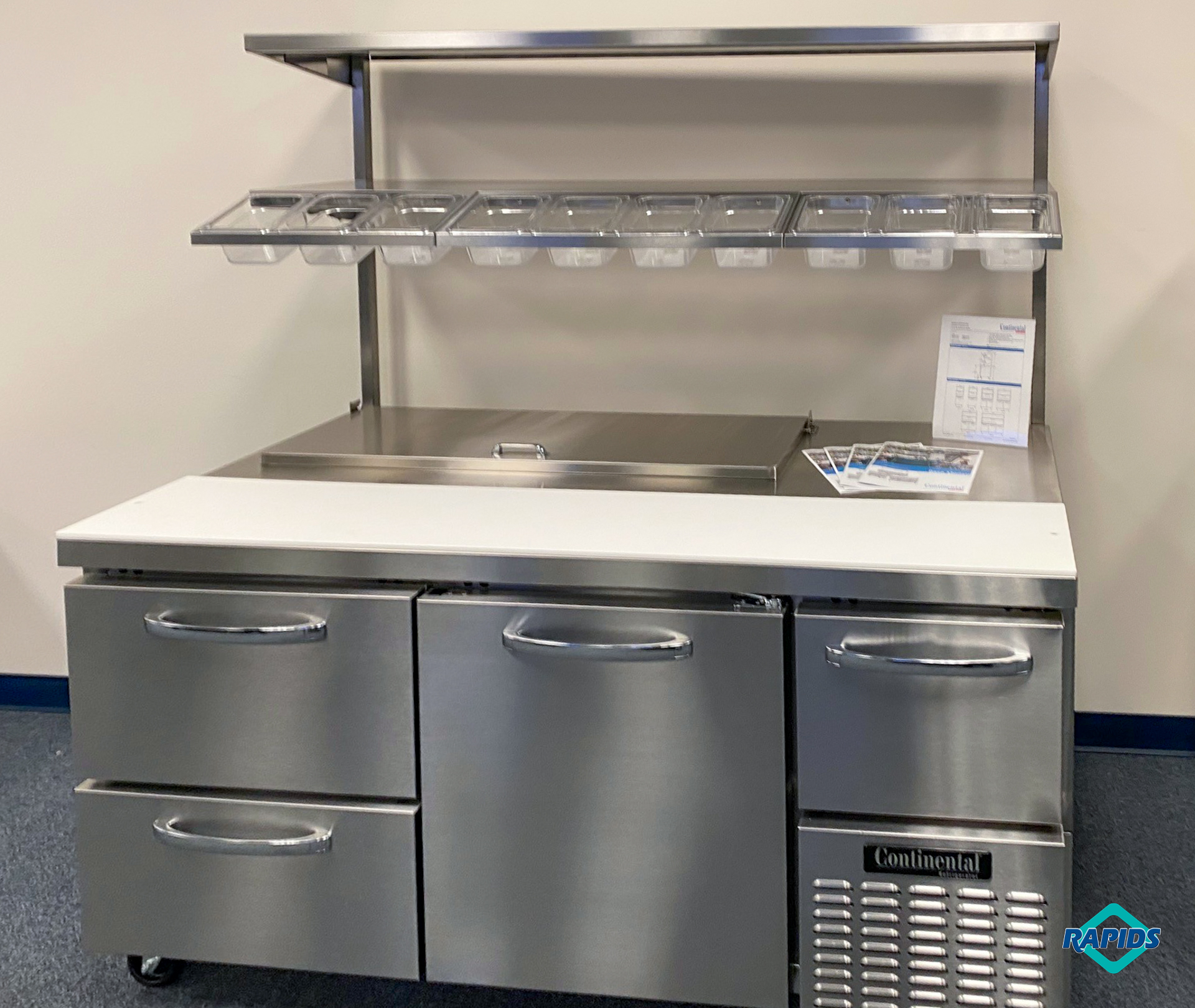
Instead of being locked into fixed configurations, Continental allows you to mix and match drawers and doors within the same footprint. In practice, that means:
- Swapping doors for drawers in high-volume prep areas
- Using drawers for portion-controlled environments (schools, healthcare, correctional facilities, and high-volume institutional settings)
- Maintaining doors where bulk storage makes more sense
For future projects, this gives us the ability to tailor refrigeration to workflow, not force operations to adapt to equipment
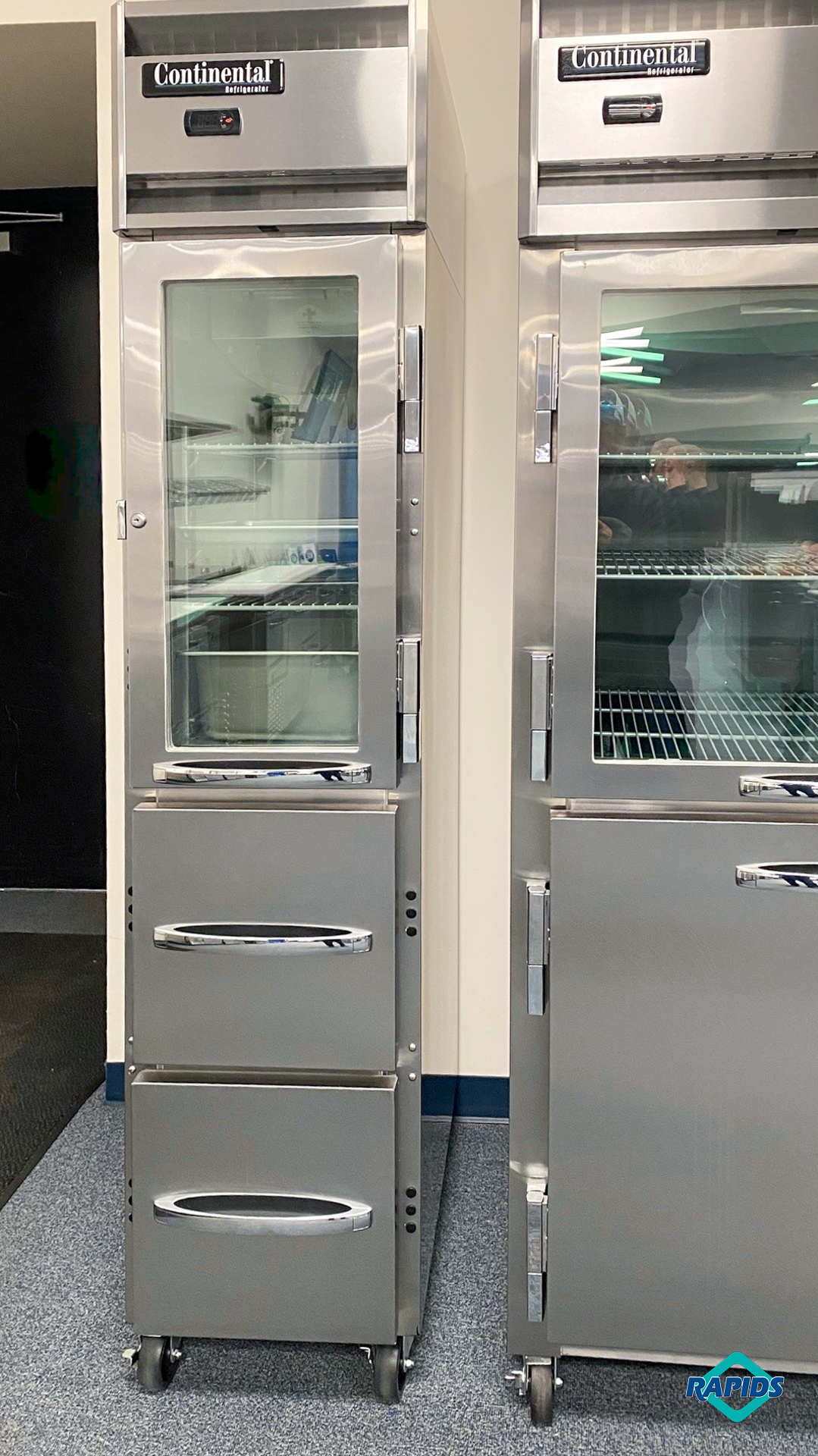
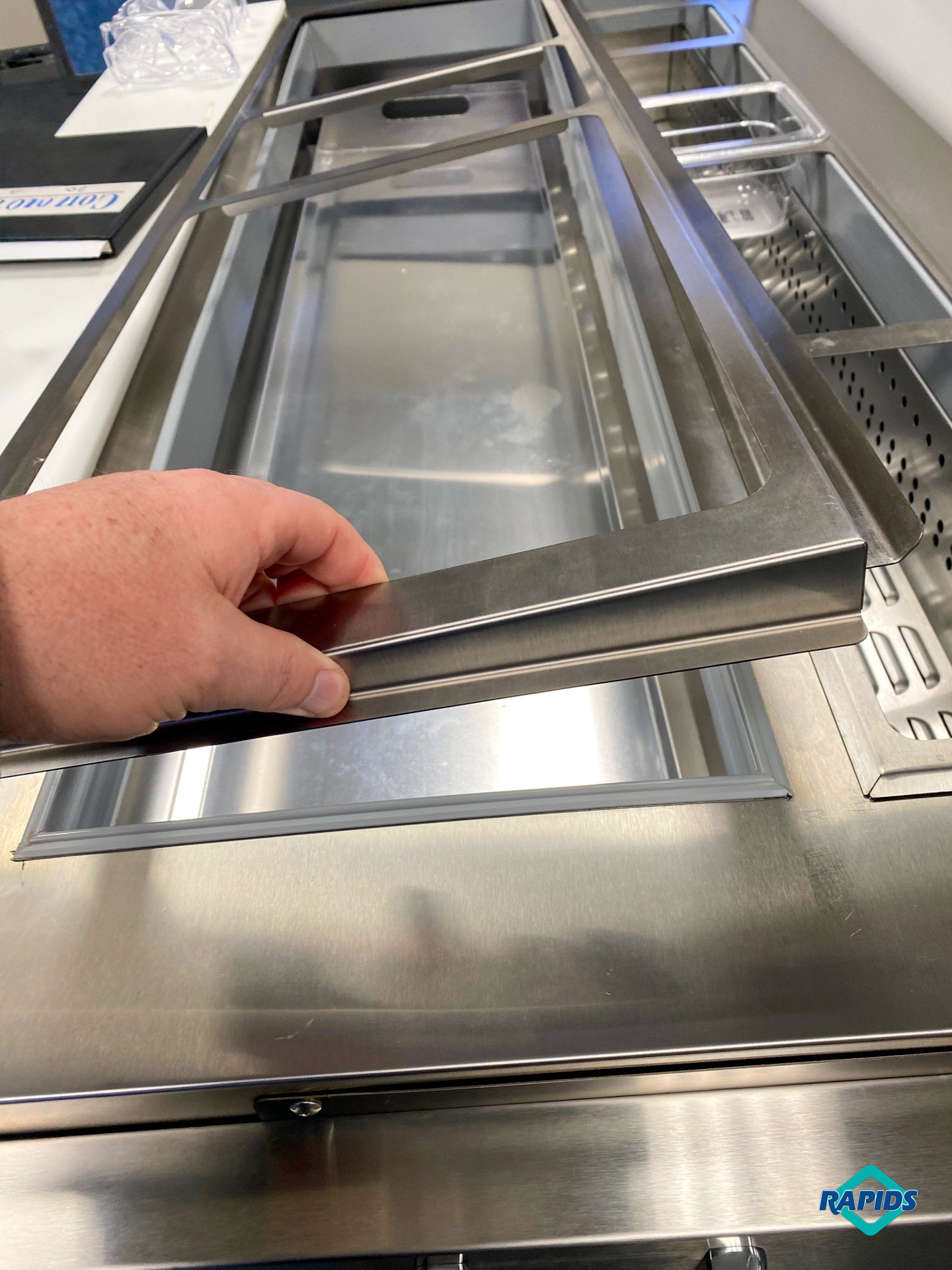
Hidden Capacity: Refrigerated Space Above the Compressor
Another standout feature is their ability to reclaim usable refrigerated space above the compressor section.
Many budget manufacturers sacrifice that space entirely. Continental’s design minimizes that loss, giving operators more usable cubic footage in the same footprint, a small detail that becomes a big deal in a tight kitchen.
Accessories That Actually Matter
We often talk about “customization,” but Continental approaches it in a way that’s practical and cost-conscious.
Their accessory ecosystem allows us to fine-tune builds without driving up project costs:
- Alternate shelving and pan configurations
- Worktop and backsplash variations
- Drawer layouts and dividers
The key takeaway: we can dial in equipment to match a concept without needing fully custom fabrication.
Refrigeration Systems: Expansion Valve vs Cap Tube
One of the more technical, but critical, differences discussed during the visit was their use of expansion valve systems versus the capillary tube systems commonly found in lower-cost units.
- Expansion Valve: Adjusts refrigerant flow dynamically based on load and conditions, improving efficiency and temperature consistency
- Capillary Tube: Fixed restriction: simple and inexpensive, but cannot adapt to changing conditions and is generally less efficient
Continental’s use of expansion valves means:
- Better performance under varying kitchen loads
- More stable product temperatures
- Improved energy efficiency over time
From a consultant perspective, this is one of those “invisible” upgrades that directly impacts food quality and long-term operating cost.
Installation Flexibility: Solving Access Challenges Without Compromise
A particularly valuable design feature is how the refrigeration package and shroud can be removed and reinstalled directly in the field. While this is certainly beneficial from a technical standpoint, where it really stands out is in its ability to solve one of the most common and frustrating issues we face on projects - limited access.
In many kitchens, especially renovations, historic buildings, or tight urban footprints, getting equipment into the space can be just as challenging as designing it. Narrow doorways, tight hallways, low ceilings, and confined back-of-house paths often dictate what can be installed, rather than what should be installed.
This is where Continental’s design becomes a major advantage. By allowing the unit to be partially disassembled, we gain the flexibility to move components through restrictive access points and then reassemble them once inside the space. It effectively removes a major constraint from the design process.
In real-world terms, when a fully assembled unit won’t fit through a doorway or around a tight corner, we no longer have to compromise on equipment selection or redesign the layout. Instead, we can confidently specify the right piece of equipment, knowing there’s a practical path to getting it installed without costly modifications or disruptions to the project timeline.
How This Impacts Future Designs
Walking the factory floor reinforced something we don’t always see in spec sheets - intentional design.
Here’s how this visit will influence my approach moving forward:
- Specify flexibility upfront: Use drawer/door combinations to match workflow, not just footprint
- Maximize space efficiency: Leverage designs that reclaim compressor-area storage
- Prioritize system performance: Favor expansion valve systems for consistency and efficiency
- Design for serviceability: Select equipment that can be maintained without specialized intervention.
Final Thoughts
Visits like this are a reminder that not all refrigeration is created equal. Behind the stainless steel exterior, the differences in engineering, accessibility, and performance can have a lasting impact on operations.
Continental Refrigerator stands out not just for what they build, but how thoughtfully they build it.
And as designers and consultants, that gives us better tools to create kitchens that actually work.
For more information and to engage with our team, please contact us via our contact form or at (866) 503-2655. We look forward to working with you to provide the best solutions for your needs.


LET'S FIND YOUR SOLUTION
Rapids Contract & Design serves the United States with locations in Iowa, Minnesota, and Missouri. Our experts are ready to assist with your foodservice needs—contact us for support, Monday through Friday, 8 AM to 5 PM CST.
or call (800) 899-6604